After the Armenian Resolution: Steps, Ruptures, and Memories in Post-migrant Society
In collaboration with AKEBİ e.V.
Sat., 25.4.2026
17:00–22:00
Free entry
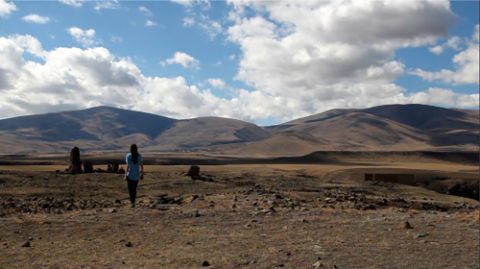
Video still from Sahman-Grenze-Kuş, Performance by Jasmin İhraç. Photo: Leyla Cömert
On 24 April 1915, hundreds of Armenian intellectuals were arrested in Constantinople (present-day Istanbul). The date has since become the political and symbolic threshold of the genocide against the Ottoman Empire’s Armenians and other non-Muslim communities. What Armenians call the Aghet—the catastrophe—resulted in the murder of an estimated 1,5 million people, mass deportations into the Syrian desert, and the dispersal of survivors across the globe. More than a historical event, the genocide constitutes an ongoing rupture: in language, in kinship structures, in cultural transmission, and in the collective visions of responsibility, justice, and coexistence shaped by both denial and remembrance.
In a 2016 resolution, the German Bundestag officially recognized these crimes as genocide, acknowledged Germany’s historical responsibility as an ally of the Ottoman Empire, and called for renewed efforts at remembrance, reconciliation, and education. Yet the broader political and social consequences of this acknowledgment remain contested. A decade on, within Germany’s postmigrant society and particularly among members of the Armenian diaspora, the resolution remains a site of reflection and debate: What does recognition mean in practice when it occurs without legal obligation? How does memory culture unfold between state acknowledgment and persistent denial? And how can solidarities emerge across communities historically positioned on opposing sides of violence?
With this diverse programme, HKW opens a space to engage with these questions through art, scholarship, and collective dialogue. Organized in collaboration with AKEBI, a Germany-based initiative of activists connected to Turkey committed to confronting the legacies of the Armenian Genocide and fostering Turkish-Armenian dialogue, the programme foregrounds solidarity as both an ethical commitment and a political practice.
Programme
17:00
Performance
Sahman-Grenze-Kuş
By Jasmin İhraç
Safi Faye Hall
Sahman-Grenze-Kuş by choreographer and dancer Jasmin İhraç is a solo performance engaging with the experiences of the ruined city of Ani, on the Turkish-Armenian border. The work approaches the complexity of the site, exploring questions of border, trace, tradition, and the transmission of memory. Through an interplay of different layers of presence and by combining live performance with film material, it creates a dialogue between media, temporalities, and spaces.
17:35
Resignifying Ceremony: Mari Beylerian Garden
Garden, Spree side
Մառի Պէյլերեան (Mari Beylerian) was an Armenian feminist activist, educator, writer, and public intellectual born in Constantinople in 1877. The resignifying ceremony recontextualizes the Mari Beylerian Garden as a site of rememberance, honouring her legacy within the broader context of the history of the Armenian Genocide.
18:30
Film screenings
Introduction by Öndercan Muti
Safi Faye Hall
Chienne d’Histoire (Barking Island)
Serge Avédikian, 2010, Frankreich, 15', French with English subtitles
Constantinople 1910. The streets are overrun with stray dogs. The newly established government, influenced by Western models, consults European experts to determine a method of eradication, before suddenly deciding, on its own, to deport the dogs en masse to a deserted island outside the city.
Director’s Note: “This historical episode remains deeply misunderstood in Turkey. Successive authorities attempted to erase it from public memory, along with the entire history of the late Ottoman Empire. I was struck by the perverse nature of the relationship between Europeans and Turks at the time. One hundred years later, I set out to cinematically explore the state of mind of the time.”
Epistemic Space
Chantal Partamian, 2015, Libanon/Armenien/USA, 18', English
Epistemic Space (2015) is a documentary short developed during the Armenia-Turkey Cinema Platform Project Development Workshop at the Golden Apricot International Film Festival in Yerevan. Set in April 2015, the film follows a mass march along Istiklal Street, where thousands gathered under the slogan “We are here.” By layering this charged moment with the history of Kamp Armen and the Gezi Park riots, the film traces the presence of Armenian lives in the city. Through this palimpsest of protest, memory, and buried histories, it constructs an epistemic space evoking the ghosts of past violence while questioning how collective histories are continuously negotiated and made perceptible.
19:30
Panel Discussion
With Banu Karaca,Tigran Petrosyan and Elke Shoghig Hartmann,
moderated by Öndercan Muti
Safi Faye Hall
In 2016, the German Bundestag officially recognized the expulsions and massacres of Armenians and other Christian minorities in the Ottoman Empire during World War I as genocide. After decades of expert discussions and parliamentary debates, it also acknowledged the role and complicity of the German Empire in the systematic persecution and murder of over one million Armenians.
To mark the tenth anniversary of this resolution, the discussion will focus on the political and social consequences of this recognition and will address key questions that have been raised in the debate since then: What does Germany’s historical responsibility as an ally of the Ottoman Empire mean in a post-migrant society? How can the examination of the Armenian Genocide be permanently embedded in a shared practice of remembrance? And to what extent can processes of remembrance and reconciliation contribute to a more inclusive and self-critical memory?
The event highlights existing and emerging solidarities between communities that historically stood on different sides of violence. At the same time, the discussion will address key tensions in German memory politics and realpolitik, as well as the debates surrounding the recognition and denial of the genocide.
21:00
Music
With Talin Hajintsi (oud), accompanied by Chrysanthi Gerogiannaki (percussion)
Angie Stardust Foyer
In her practice, singer and oud player Talin Hajintsi continues a form of collective healing. Traditional Armenian songs and dances act as a unifying force within the community. Inspired by her grandmother, Hajintsi collaborates with percussionist Chrysanthi Gerogiannaki to create a performance that invites the audience to sing along, dance together, laugh, and cry. Armenian culture is brought into the present—a gesture of resistance and a source of empowerment for communities.
Snacks & Drinks