Oscar Ngu Atanga
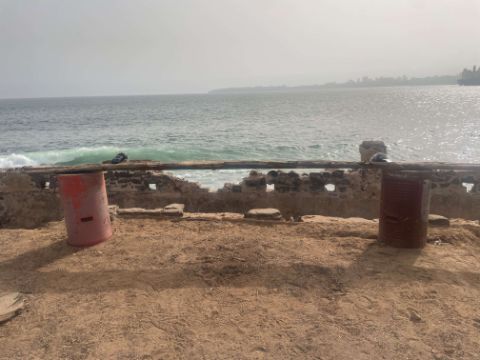
Oscar Ngu Atanga, field recording in Gorée, Senegal, for Wax Echoes: Unwritten Notes (2026). Courtesy of the artist
Oscar Ngu Atanga’s practice begins in the auditory realm. He uses archival sound fragments, field recordings, compositions, and songs to create installations and live performances. For Atanga, sound serves as a testimony and a political statement, preserving ancestral legacies through storytelling. His work also encompasses spatial arrangements, textile designs, and writing. Wax Echoes: Unwritten Notes (2025–26) addresses a sound archive of Humboldt University Berlin, where these recordings are etched onto cold shellac discs. They contain testimonies of Tirailleurs from formerly colonized countries in the French, British, and Russian armies who were captured as prisoners of war by German forces during the First World War. German scientists recorded them as part of a catalogue of languages. While the speakers in these recordings were reduced to phonetic samples and grammatical data for colonial knowledge production, Atanga’s work reverses this historical flattening of voices. By rearranging and supplementing the original recordings with new soundscapes from Benin, Senegal, and Germany, the multichannel installation transfers these voices into the present, making their human presence felt in space. Listening becomes an act of witnessing and resisting colonial appropriation.
Commissioned by Haus der Kulturen der Welt (HKW), co-produced by Oscar Ngu Atanga and HKW, 2025–26
Work in the exhibition: Wax Echoes: Unwritten Notes (2025–26), multichannel sound installation, textile, text. With contributions by Elise Agbodegbe (weaving), Jacopo Biffi (audio engineering), Anna Diagne (text design), Gaëlle Dogo and Pascal Tohouedo (tailoring), Papi Ndoye and Akele Wéwé Tatchéyon (translation). Courtesy of the artist, archival material courtesy of the Fondation Zinsou Benin (with thanks to Halima Moumouni and Laura Fagbohoun), and Lautarchiv der Humboldt-Universität zu Berlin