Knowing by Ear: Listening to Acoustic Traces of Tirailleurs in Berlin
Anette Hoffmann
Keynote Lecture
Sun., 14.6.2026
14:00–15:30
Safi Faye Hall
In English
Free entry
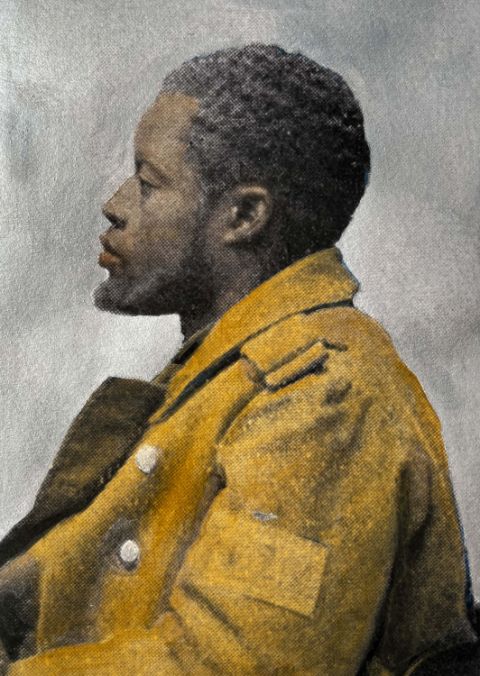
Abdoulaye Niang, photographed by Wilhelm Doegen, 1917, hand colourized by Anette Hoffmann(2024). Image: courtesy of the artist
During the First World War, thousands of young African men were conscripted to fight for France and Britain. Many of them were captured and held as prisoners of war (POWs) in Germany, where their stories and songs were recorded and archived by the Königlich-Preußische Phonographische Kommission (Royal Prussian Phonographic Commission), and later became part of the Lautarchiv at Humboldt-Universität, Berlin. Even when recorded under duress, these acoustic collections constitute significant yet under researched resources for new historical perspectives and alternative knowledge production.
In this keynote lecture, Anette Hoffman outlines the history of these recordings and her own research with the collection at the Lautarchiv. Hoffmann foregrounds the voice, the content of the recording, and historical position of the speakers rather than treating the recordings as ‘linguistic research’. The lecture focuses on one particular speaker: Abdoulaye Niang (1878–1919) from Dakar, who fought in Regiment 234 of the French infantry. He was later wounded, captured, and interned at the Wünsdorf POW camp near Berlin. Abdoulaye’s presence in Europe left an archival trace across various institutions and collections, which remained unheard for many decades; in recent years, his recordings have been translated from Wolof by Serigne Matar Niang and Fatou Cissé Kane. In them, Abdoulaye sang about the recruitment campaigns undertaken by the colonial French army that resulted in him and other African men being sent to join the war in Europe, but also of his desire to return home of Dakar. In following his traces across the archives, Hoffman demonstrates how Abdoulaye's recorded voice continues to resonate today. She also introduces the project Echo travels, which was recently initiated in Cape Town with the aim of allowing listeners to engage with his acoustic echo in the present.