Juan-Pedro Fabra Guemberena
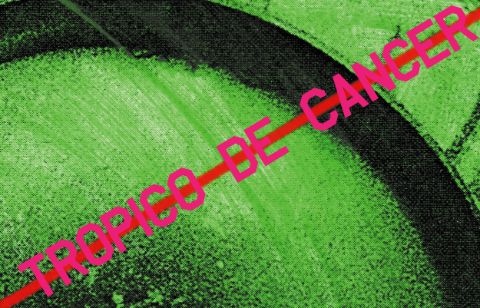
Juan-Pedro Fabra Guemberena, Trópico de Cáncer (2026)
In the late 1970s, Juan-Pedro Fabra Guemberena and his family fled Uruguay’s military dictatorship to settle in Sweden. The experience of exile became the starting point for his diverse artistic practice. In photographs, sculptures, multimedia artworks, and interventions in public space, he addresses war and other forms of institutional and systemic violence. Campaign banners are a recurring element in his work, as seen in the three flags with all-caps text and striking colour contrasts displayed on the rooftop terrace of HKW. Trópico de Cáncer (2026) refers to the geographic latitude north of the equator, which marks NATO’s defence perimeter and thus establishes a categorical division between lives deemed ‘worth protecting’ and those south of the line, considered ‘expendable’. Unbekannt (2026) alludes, on the one hand, to the figure of the anonymous soldier, the unnamed victims of the First and Second World Wars buried across regions, including in Germany, and on the other, to the countless people injured or killed in ongoing wars, facilitated by the weapons industry that sustains such conflicts. In this war your uniform will be your skin, and you cannot take it off (2026) explores the question of individual loss in the face of warfare. Using geopolitical, national, and body-political perspectives, Fabra Guemberena highlights the scalability of violence and oppression. The flags extend his work into the outdoor area of HKW, underscoring how the conflicts explored inside the exhibition resonate in the immediate present and call for accountability.
Works in the exhibition: Trópico de Cáncer (2026) flag, 450 × 700 cm; Unbekannt (2026), flag, 450 × 700 cm; In this war your uniform will be your skin and you cannot take it off (2026), flag, 450 × 700 cm. All courtesy of the artist and V. Ankarcronat