Abrie Fourie
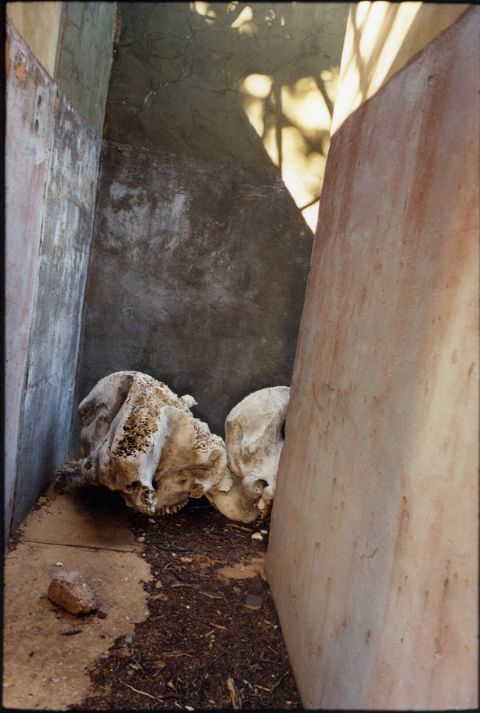
Abrie Fourie, Former 32 Battalion Military Base (SADF), Bwabwata National Park, Namibia (2024). Courtesy of the artist
Abrie Fourie’s practice evolves as an archive of memory, using photography, and more recently, sound, to reflect how a place carries more than that which can be seen. Tacit Consent: Archive of a Conscripted Mind—Seeing with a Listening Ear (2024–26) returns to the territories in Namibia that Fourie first encountered as an eighteen-year-old conscript in the South African Air Force during the later phase of the Namibian War of Independence. Although typically cast as a regional conflict, the war also involved Cuban, East German, Russian, US, and Portuguese actors, fighting the Cold War in a proxy war of twenty-four years of revolt, until Namibian liberation in 1990. In revisiting the once-militarized terrain, Fourie exposes the depths of geotrauma and reclaims it in an artistic form. As some of his images drift into a blur, others are sharply defined, reflecting how memory oscillates between the distinct and the ungraspable. The question of complicity, of having served in a war he neither understood nor supported, on land that was not his own, echoes other histories of young soldiers conscripted into geopolitical agendas, including the Tirailleurs. Retracing a 4,000-kilometre route through Namibia, Fourie photographs landscapes and architectures, takes field recordings, and speaks to those living in the war’s aftermath. The resulting dialogue between image and layered soundscapes of birds, insects, and everyday commotion shifts the work from recollection to reckoning: the memory of war endures not only in what is seen but in the survival and the vividness of nature that remains.
Work in the exhibition: Tacit Consent: Archive of a Conscripted Mind—Seeing with a Listening Ear (2024–26), multichannel sound installation, 27', hand-printed C-prints, b/w photographs on baryta, doublesided hanging prints on blackout fabric, 12 each 40 × 60 cm and 2 each 225 × 150 cm. Courtesy of the artist. The research for Tacit Consent was made possible by the Gwaertler Grant. Thanks to Aimée Lehmann and Dr Johannes Lehmann