Moonlight Benjamin | Bab L' Bluz
Concerts
19:00–20:15 Moonlight Benjamin
20:45–22:00 Bab L' Bluz
22:00–00:00 DJ-Set Kawtar Sadik (Magnus Hirschfeld Bar)
Sat., 11.7.2026
19:00–00:00
Paulette Nardal Terrace
€24 / reduced €20
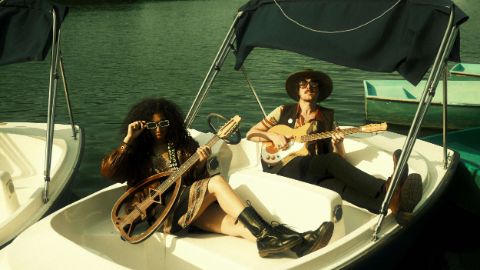
Bab L' Bluz. Photo: Karim Chater
Moonlight Benjamin
The singer Moonlight Benjamin combines Vodún, rock, and punk like no one else. Her voice is dark, raw, and challenging; her songs fast, rhythmic, and rebellious; her attitude austere and forceful. She offers outstanding proof of the rhythmic and spiritual links between Gnawa and Vodún. Moonlight Benjamin digs for the roots of rock and finds them in the blues and in West Africa. Clearly influenced by the great Oumou Sangaré and the driving guitars of 1970s rock, she demands freedom and respect with her shamanic stage presence. Her career began in 2018 with her debut album Siltane, that immediately captured people’s attention, followed in 2020 by the equally explosive Simido. She describes her new album Wayo as a ‘cry of pain’; still centred on Haiti, her tormented homeland, it also explores other parts of the world and addresses philosophical questions. Born into a Vodún-practicing family in Port au Prince, she spent her childhood in a Catholic orphanage after her mother died in childbirth. Here she came to know and appreciate gospel singing, not returning to her roots until her teenage years before leaving Haiti for France in 2002. Whereas her debut album was still dominated by traditional drums and singing, the instrumentation became rockier with each release, but she still sings in Haitian creole, with a challenging energy.
Bab L' Bluz
Whereas last night, Asmaa Hamzaoui brought the guembri back to its ritual place, tonight Yousra Mansour plugs it into an amplifier and sends it into the psychedelic rock of the twenty-first century. The Moroccan-French band Bab L’Bluz – ‘Gateway to the Blues’ – is a must for anyone wishing to know what’s going on musically in Morocco today. Founded in 2018 in Marrakesh, when the charismatic singer Yousra Mansour from El Jadida met the guitarist and producer Brice Bottin, the quartet with flute and drums has created a sound that could only emerge on Morocco’s Atlantic coast. Mansour plays an electric awisha, the smaller sister of the guembri, while Bottin plays an electrified guembri—and the result cannot be assigned to a single category: Gnawa trance, Hassani songs from the south, Amazigh rhythms and Reggada, Chaâbi, sub-Saharan elements, as well as funk, Afrobeat and solid, hypnotic rock in the spirit of the late 1960s and ‘70s. Mansour, who grew up in El Jadida with the voice of Fairouz, the Gnawa sounds from nearby Essaouira, and the voices of Janis Joplin, Oumou Sangaré, and Erykah Badu, sings only in Darija, the Moroccan form of Arabic—lyrics about freedom, against corruption, for the possibility of a different life. Her celebrated debut album Nayda! (2020), named after a Moroccan youth movement that campaigns for a creative reclaiming of local heritage, was released on Peter Gabriel’s Real World Records. In 2021, the band won the Songlines Music Award in the fusion category. In 2024 came a second album, Swaken, billed as ‘ancient-to-future music’. Within the two days of the festival devoted to the women in Gnawa culture, Bab L’Bluz is the high-frequency counterpart to the previous evening’s focussed ritual: here the maâlma on the guembri between Casablanca and lila, there a Doukkala with an electric awisha between El Jadida and Real World—two answers to the same question of what it means to be a female voice in a tradition which for so long would allow only male voices.