Aficionado – Flamenco Moro | Aly Keïta Trio | Hassan Boussou
Concerts
18:00–19:00 Aficionado – Flamenco Moro
19:15–20:00 Aly Keïta Trio
20:30–22:00 Hassan Boussou
22:00–00:00 DJ-Set Kabylie Minogue (Magnus Hirschfeld Bar)
Sat., 4.7.2026
18:00–00:00
Paulette Nardal Terrace
€24 / reduced €20 (Evening ticket)
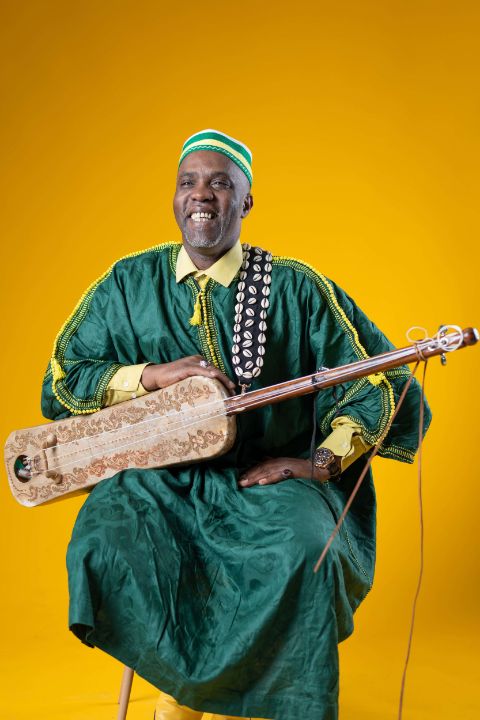
Hassan Boussou. Photo: Promo
Aficionado – Flamenco Moro by Alaa Zouiten Sextett
Fourteen kilometres separate Tarifa and Tangier. The world’s shortest crossing between two continents—and for centuries one of the most travelled. From the eighth century, the Moors brought their musical modes, their lutes, and their poetics to al-Andalus. Seven centuries later they were driven out, but the sound they left behind never went away. It lives on in flamenco—a music that is Spanish without ever having been purely Spanish. Aficionado – Flamenco Moro takes up this dropped lineage and rethreads it. The sextet’s leader is the Casablanca-born oud player and composer Alaa Zouiten who has been living in Berlin for years. He has released three albums and has been working for over a decade on transcultural projects between Morocco, Europe, and the Arab world. What Zouiten discovered in his years of engaging with flamenco was not least his own Moroccan tradition, heard through the ears of its distant sister. The name of the project is a tribute: in Andalusia, aficionado is the name given to those who live not from the tradition but for it—who sing in the peñas, who immerse themselves with patience and humility in this music that is not their own, but that can eventually become theirs. This is how Aficionado see themselves: as a declaration of love for flamenco from a Moroccan perspective, and as a rediscovery of the place where the two traditions had not lost sight of each other. And then there’s another, deeper place where Morocco and Andalusia meet: the duende. What Federico García Lorca described as the dark, obsessed depths where the true voice of flamenco is born, is known to Gnawa and other Moroccan trance-based practices under another name—the same frisson wandering back and forth across the strait. The group’s debut album, released in April 2025, quickly raised the project’s international profile: four stars in the British magazine Songlines, number 17 in the Global World Music Charts, tours to China and Morocco, invitations from all across Europe. At the festival, Aficionado fills a gap: in among Gnawa’s travels to Mali, Brazil, Cuba, Haiti, and Italy, it leads not across the Atlantic but across the strait—back to the southern Spain that has long been an echo of Morocco. Instead of crossover, then, what this evening has to offer is a homecoming in two directions at once.
Aly Keïta Trio
Singer, balafon player, composer, and established figure in Berlin’s vibrant jazz scene, Aly Keïta has just released his latest album Balafon Evolution, recorded with his Berlin trio, with Marcel van Cleef on drums and Roberto Badoglio on bass. Cleef and Keïta have been playing together since 2008, with Badoglio joining in 2014, and they have toured worldwide. For the album they invited Mariam Koné to appear as guest vocalist, and she also accompanies them for their concert at HKW. Their repertoire includes African rhythms, jazz, and improvisation. Aly Keïta was born in Abidjan, Côte d’Ivoire. He learned to play balafon from his father, a respected Mandingo griot, and then moved with his brother to live with his grandmother in Mali where, following the family tradition, they built and played balafons. At eighteen, Aly Keïta had already developed a reputation as a balafon virtuoso; being booked by successful musicians for world tours brought him into contact with jazz, which became an enduring interest. He was the first to play the balafon, previously used for percussive accompaniment only, as a solo instrument, capable of being tuned chromatically, to lead the melody at the centre of the stage and as the focus of the show. In this way, he set new standards and opened new possibilities for the following generations of balafon players.
Hassan Boussou
The festival doesn’t let a day pass without Gnawa—but this evening the entire programme has been leading up to it. We began on the northern shores of the Mediterranean with Aficionado – Flamenco Moro, where Gnawa resonates as an unspoken subtext. We continued with the Aly Keïta Trio: Mandingo balafon from Côte d’Ivoire and Mali, embedded in jazz and improvisation. And now the evening culminates in an authentic Gnawa concert with the maalem Hassan Boussou from Casablanca. This programming is not arbitrary: this sequence of three sets is essentially a single line drawn across the Andalusia-Maghreb-Sahel continuum, with Gnawa itself at the southernmost point. Hassan Boussou is the son and musical heir of the legendary maalem Hmida Boussou, a major figure in the Gnawa brotherhood of the twentieth century. According to tradition, the Boussou family comes from the area around Lake Chad—a biographical trace that leads back directly to the sub-Saharan roots from which Gnawa first emerged as the sound of an entire history of migration. Hassan Boussou has never treated this tradition like a frozen museum exhibit: in 1996, he founded the band Gnawa Fusion in Belgium and he has worked with jazz musicians like Bojan Z and Julien Lourau, while never losing touch with his heritage.
At the end of his concert, he welcomes a special guest on stage—Aly Keïta returns with his balafon. Guembri and balafon, both with the same roots, come together for a last piece of music: a closing chord that restates the underlying concept of this festival—that Gnawa is not an island, but one nexus in a musical network that extends much further.