What Is Volunteering?
In the summer of 2022, at the height of China’s Zero-Covid policy, I resettled in my hometown in southern China. One evening, during the daily mandatory Covid-19 tests organized by the government-run neighbourhood committees, my husband got into an argument with a volunteer who refused to let him take the test because he wasn’t wearing a mask. Lacking a valid health code from the daily test result meant that he could not enter any public facilities or residential compounds, including his own. Exhausted, my husband ranted about the never-ending control. Other personnel, all wearing ‘volunteer’ armbands, came and tried to mitigate the situation, urging us to cooperate. One of them stressed that they were only volunteers. ‘We are trying to help as much as we can. You can help us by following the guidelines.’
The message from the volunteer was twofold. First, they were doing this out of kindness, to which we should respond with kindness. Second, and perhaps more importantly, they were simply reinforcing state policy, without any power to influence it.
The day after, we called the neighbourhood committees to inquire about the volunteers in our area and were told that they were supporters recruited and remunerated by the committees. If the word ‘volunteer’, derived from Latin and Hebrew roots, signifies ‘generosity’ and ‘free will’, are volunteers who only follow state guidelines really offering their free will? Are they volunteers when they are financially rewarded? Or are they temporary workers employed by the state?
In the article ‘Defining Who Is a Volunteer: Conceptual and Empirical Considerations’,[1] the range of activities ‘volunteerism’ can imply is under scrutiny. The term, as the authors note, despite its prevalence, lacks a ‘clear and coherent definition’ in contemporary usage. Based on literature review, textual analysis, and interviews, the article presents four core characteristics determining the scope of volunteerism in public eyes, ranging from pure to broad:
Is the act based on free will, coercion, or obligation?
Is there no remuneration at all, or is there a small amount?
Is the act organized formally or informally?
The intention of the act is to benefit others, or is the doer also a beneficiary?[2]
Here, volunteerism in the broadest sense—that is, obligatory work with a moderate amount of financial compensation that also benefits the doer (with or without formal organizing)—shows little difference to wage labour. What differentiates the two may hinge on whether the action contains elements of altruism and concerns a larger public. Indeed, volunteerism is often legitimized when it adheres to the recognized value of the common good. Here, the volonté (will) in volunteerism may not refer to individual will but to volonté générale (general will), a political ideal made popular by political philosopher Jean-Jacques Rousseau in the eighteenth century was included in Article 6 of the Declaration of the Rights of Man and the Citizen (1789) during the French Revolution. It refers to the will of the people—members of the society—as a whole. Volonté générale is bound to an idealized concept of ‘the people’ who gear their value system and moral sense towards a common ground within a self-governed society. Although Rousseau repudiated the criticism that the volonté générale heralds authoritarianism, this political theory has nonetheless brought obscurity to what ‘the people’ entails and, therefore, how to identify, measure, and exercise their will.
In the Dictionary of Populism, the entry ‘General Will (Volonté Générale)’ emphasizes the foundational work volonté générale lays for populism, as it provides a homogenous understanding of ‘the people’—the ‘authentic’, elite-smashing people.[3] In the development of the modern political system, the mythologized, abstract ‘people’ have become the absolute political subject, wielding their willpower to determine what is good for the public and what is not. Correspondingly, in contemporary volunteerism, the philanthropic ‘free willers’ and their gestures of kindness seem to embody versions of the volonté générale based on different political narratives, highlighting that their actions are by the people and for the people, whoever ‘the people’ are.
After the incident, I began to notice the ubiquitous presence of volunteers in a country that was waging a people’s war against Covid-19: they ran testing stations, monitored unauthorized gatherings and non-maskers in public spaces, conducted door-to-door canvassing, and collected resident data.[4] According to an Initium article,[5] volunteers supporting China’s pandemic control were primarily composed of personnel dispatched from public institutions and external recruits. Some volunteers were dissatisfied with being required to perform voluntary acts as work assignments, which undermined their willingness to serve the community. As one social worker notes in the article, social-work organizations are merely the bastard children of neighbourhood committees.[6] The palpable alliance between state mobilization and volunteerism is perhaps a fitting example and starting point for examining the politics of ‘volunteerism’ and the modern construction of ‘free will’.
Who Is Volunteering?
In China’s twentieth century of long revolutions, military and political mobilization played a pivotal role in reshaping ordinary people into national subjects—a process through which personal will was blended into the conceptualization of the modern nation. The emergence of ‘volunteerism’ came precisely in the era of mass communist mobilization. In mainland China’s monolithic political discourse, volunteerism has never felt separate from the state project. Growing up, the most well-known references to ‘volunteers’ were the ones from the national anthem, ‘March of the Volunteers’ (義勇軍進行曲) (1935), and the People’s Volunteer Army (中國人民志願軍) of the Korean War (1950–53).
In the former case, ‘volunteers’ refer to the Northeastern Volunteer Righteous and Brave Fighters, an anti-Japanese armed force formed in response to the Japanese invasion and subsequent occupation of Manchuria in 1931. The term ‘Righteous and Brave Fighters’ (義勇軍, yi yong jun) is likely borrowed from the Japanese expression 義勇兵 (giyūhei), widely used in Japanese militarism from the early to mid-twentieth century. A potential reference for the terminology is Japan’s prewar educational principles, articulated in the Imperial Rescript on Education (1890), where individuals are instructed to ‘offer yourselves courageously to the state, should emergency arise’ (一旦緩󠄁急󠄁アレハ義勇公󠄁ニ奉シ). Here, 義勇 implies the sacrifice of the individual to greater political demands, or, more accurately, the integration of personal and national interests.[7] Correspondingly, the lyricist of the ‘March of the Volunteer’, the Japan-educated Tian Han, also calls for China’s volunteer troops to ‘build our new Great Wall with our flesh and blood’. To be ‘righteous and brave’ is to become a modern national subject whose personal value resides in the fate of the nation.
In the second example, ‘volunteer’ refers to state military forces under the guise of volunteerism to avoid direct interstate war. Here, the Chinese terminology for ‘volunteer’ shifts from the Japan-origined 義勇 軍 to 志願軍 (zhi yuan jun). Signifying ‘aspiration’, ‘hope’, and ‘volition’, the future-oriented 志願軍 continues to blur the boundary between personal and national prosperity, paving the way for the emergence of contemporary community volunteers, 志願者 (zhi yuan zhe).
The interpretation of ‘volunteerism’ as ‘devoting and sacrificing oneself for the nation’ isn’t a Japanese invention. It is based on the western military tradition, to which Japan has been deeply aspired since the mid nineteenth century. First used as a military term in the mid eighteenth century, ‘volunteer’ specifically referred to soldiers who are neither conscripted nor paid for their service. During the War of American Independence (1775–83), for instance, the so-called civilian soldiers, or patriot volunteers, played a significant role in the Continental Army’s final victory. The British Volunteer Movement at the turn of the nineteenth century saw the emergence of a patriotic military force to defend Britain against potential invasions in the homeland and upheavals in the colonies. By 1804, as Austin Gee has shown, eighteen percent of British men of military age joined the volunteer force. Patriotism, imperial, and/or national pride, are often cited as reasons for volunteerism.[8] Here, rather than regarding the rise of volunteerism among soldiers as a result of nationalist sentiment, it might be more accurate to analyse volunteering as a process that actively builds nations, national subjects, and national sentiments. Apart from binding individuals’ fates to those of the nation through wars, volunteerism is also crucial for maintaining state stability by, as Gee notes, ‘gaining the active involvement of civilians and strengthening the ties of social allegiance’.[9]
John M. MacKenzie describes the military volunteerism in Britain in the nineteenth century as comprising ‘a renewed militarism, a devotion to royalty, an identification and worship of national heroes, together with a contemporary cult of personality, and racial ideas associated with Social Darwinism. Together these constituted a new type of patriotism’.[10] For the empires transitioning to modernity, volunteerism shaped a poignant sense of nationalism domestically. Meanwhile, in the colonies, it initiated more complex processes that continued to embroil the colonial subject’s sense of identity, belonging, and value. These colonial experiences effectively complicate the ‘volunteerism’ discussion by destabilizing the discourse of nationalism. They pry open a realm of ambivalence and multiplicity, muddling the fixed structure of the nation state.
After the Indian Rebellion in 1857, what was then British India introduced the racial theory of ‘martial race’ and actively recruited the valiant, loyal, and ‘less-educated’ Indian groups, such as the Sikhs and Punjabi Muslims, Hindu Jats, and Gurkhas, into the army force, com- prising an all-volunteer British Indian Army. A key reason behind the invention of the martial race, as Heather Streets argues, was to exclude the more educated population from military service, thus preventing instability and uprising.[11] Similarly, in British-controlled East Africa, the Kamba were also considered part of the martial race. A hodgepodge of social Darwinist ideas, casteism, and racism, the martial race theory was adopted elsewhere, for instance, by French General Charles Mangin in his proposition La force noire,[12] which promoted the deployment of African soldiers from the colonies into wars. By the time of the First World War, the British colonial troops in Asia and Africa were exclusively volunteer forces. Meanwhile, the French military recruitment strategy in North and West Africa incorporated voluntary enlistment and conscription. Myron Echenberg notes that in the late 1920s, ‘25% of the annual contingent in French West Africa consisted of volunteers, many of whom hoped for a professional career as a Tirailleur Sénégalais’.[13] During the Second World War, colonial volunteer troops continued to expand.
Why Volunteering?
But why would men volunteer to fight for a country other than their own, not to mention for that of their colonizers? Instead of patriotic passion and nationalist pride (though they also existed), the colonial volunteer soldiers demonstrate a much more complex and sometimes disorienting interior landscape. Rita Headrick discussed the motives behind African soldiers volunteering for the British Army in the Second World War, suggesting that some volunteer soldiers in the British Army were sent by ‘their chiefs, school teachers, or European employers, thus calling into question the British assertion that their African armies were composed almost totally of volunteers.’[14] Others, based on scant documented accounts, opted for military service for ‘better food, money, and education’, especially vocational and trade training. As one Kenyan soldier explained:
Then we had been told that unless we joined up and helped the Government, Kenya would be occupied by Germans and Italians. To keep out these ‘monsters’, and also to escape the boredom and difficulty of being unemployed in Nairobi, I enlisted.[15]
A long list of different incentives can also be found in David Killingray and Martin Plaut’s compilation of oral accounts for their research on the Second World War. Below are two excerpts:
The DC’s based soldiers marched in our villages in their full uniform. They were always smartly dressed and they gave us tinned beef plus biscuits. They sang while marching so we were greatly attracted to join them with a covetous mind. We never knew it was the white man’s clever way of curbing us into the war and they never revealed where we would go. They chose only those of us who were physically fit.[16]
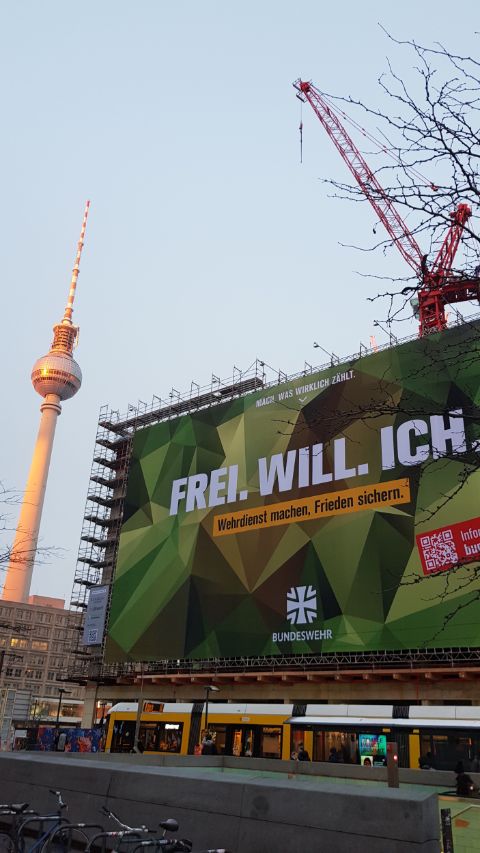
Billboard by the German Bundeswehr at Berlin’s Alexanderplatz, January 2026. ‘Frei. will. Ich.’is a wordplay evoking both the term ‘voluntary’ (freiwillig) and the phrase ‘I want free(dom)’. Photo: Eric Otieno Sumba
Landscapes of Will: The Volunteer Question
It is clear that the majority of the African soldiers came into the Army not to fight for King George VI or to defend the Empire. No. The King and the Empire meant and still mean nothing to them. The men you see in the forces came to help ... When their friend and lady told them that back in England her or his mothers were in trouble, a fierce bully was threatening to take them slaves.[17]
Timothy Parsons notes that, during the Second World War, ‘men who resisted conscription into the unarmed labor units willingly volunteered for the KAR and RWAFF to secure better pay and affirm their masculinity.’[18] There are also cases where educated men volunteered for the British Army to show their allegiance and to fight against ‘the more virulent brand of racism’ represented by the Axis powers:[19]
John Henry Smythe, who voluntarily joined the Royal Air Force in Sierra Leone, spoke for many Africans when he explained that Hitler’s racist ideology, which he encountered in Mein Kampf, ‘would put any black man’s back right up and it put mine up.’[20]
Although they dedicated their lives and endured severe hardship for the imperial military, the colonial soldiers and volunteers received unequal and racist treatment both during and after their service. Joe H. Lunn documented a set of segregation policies when more than 140,000 West African soldiers, the Tirailleurs, arrived in France and served as combatants on the Western Front in 1916. These Tirailleurs faced highly restricted regulations in terms of contact with French soldiers and civilians, especially French women. They were rarely given furloughs, and the French that they were taught was a highly simplified pidgin French, which deepened a racist stereotyping of them as ‘savage in nature’.[21]
Headrick also enumerated differences in food, housing, pay, discharge placement, and medical care between European and African soldiers:
African troops in the British army were paid far less than British troops on the grounds that the African pay scales compared favorably with the salaries of civilians back home. In fact, West Africans were paid more than East Africans. Yet Africans tactlessly reminded the British that wage differentials for identical jobs in the colonial service had been explained in terms of the British needing expatriate pay because they were away from home. Now that the Africans were away from home. Where was their expatriate pay? Conditions of leave were also dis- criminatory, and African servicemen’s clubs were more spartan than European ones. As for home leave, it could generally be granted to African soldiers stationed in the Middle East from Burma and India, though British soldiers were more likely to get home than African soldiers.[22]
Facing unfair treatment, colonial soldiers endured, defected, fled, or even attacked their officers. Parsons documented a letter sent by the Tirailleurs of the Bataillon Sénégalais de Marche No. 10 to the British Army:
Some of us have served in the Royal West African Frontier Force, before we deserted to get better pay with the French Army. We have never had any pay, nor have we had the opportunity of fighting the enemy as we were promised ... Now we say to you, English Colonel, that all the men of the B. M. 10 are willing to serve in the English Army.[23]
Many African soldiers returned to their homelands amid an economic crisis and continued to struggle for survival. The army experience encompassed a drastic process of modernization through which their sense of identity, everyday habits, customs, tastes, and desires underwent pro- found transformation. The experiences of the colonial soldiers are further complicated when Headrick points out moments of political awakening that potentially occurred during their encounters with other worlds and people:
Political consciousness was also raised, especially among American Africans stationed in Southeast Asia. In Burma they fought, but in India and Ceylon they had a chance to look around and talk with people. Africans were excited by the Indian independence movement ... but the soldiers were also shocked by the poverty of India itself.
Africans also met other Africans because of the war. West Africans met East Africans, people from one colony met people from another colony, people from different tribes within the colony met each other. Whether this promoted understanding and pan-Africanism is hard to say. There were both Europeans and Africans who claimed it did and held that the political future of Africa would be very different because of this.[24]
Whose Volonté?
The term ‘volunteer’ often provides a flattened understanding of will, suggesting a selfless willingness to sacrifice oneself for a greater cause, often responding to ‘the people’’s needs. The history of the colonial volunteers, however, radically rejects the simplification and the easy assumption of a common ground on which ‘the people’ exist. When soldiers fought voluntarily on the uneven terrain of social, racial, and political relations, for nations that did not treat them as equals, nor took them as members of the community, the illusions of ‘the people’ and the ‘common good’ burst. When nations wage war with non-citizen soldiers and on lands outside their territories, the imagination of an integral national community becomes shaky. Correspondingly, political scientist Tarak Barkawi challenges the taken-for-granted premise of ‘nation’ and ‘empire’ in the discussion of soldiering and wars, suggesting instead to examine western military histories through the lens of cosmopolitanism—the global deployment and stationing of troops and the wide applicability of military systems despite differences in culture and tradition.[25] In this sense, the two major military conflicts of the twentieth century, which rearranged the global landscape and re-established national borders, in fact carry overtones that bring the ideology of the nation state into question.
The history of colonial soldiers and volunteers in the nineteenth and twentieth centuries rarely occupies a prominent place in mainstream historical narratives produced by nation states. As Driss Maghraoui notes in his study of Moroccan colonial soldiers, they have been ‘forgotten or selectively remembered’.[26] The reasons behind such forgetfulness, apart from European nations’ deliberate avoidance or sugarcoating of their colonial wrongdoing, also lie in the ambiguities of their stories. The soldiers’ motives, experiences, observations, and life trajectories varied greatly, as did their political stances, hopes, desires, and plight. From their stories, it’s hard to clearly determine the oppressors and the oppressed, as many of them volunteered and many underwent significant processes of westernization. They can’t easily fit into the narratives of political resistance[27] or the rise of nationalism, nor were they accomplices in the expansion of imperialism.
In the standardized historical narrative that favours the nation- state structure and easy dualism, their stories feel like a misfit. It is precisely the complexity of their histories—which demonstrate how people ‘had to readapt their livelihood, negotiate their living existence, and in the end respond much differently to the colonial challenge[28]—that are worth discussing here. The question is no longer simply the violent condition under which they said ‘yes’ when they meant ‘no’. It is about why they said ‘yes’ when they meant ‘maybe’ or ‘I don’t know’ or ‘might as well since there’s no choice’; it is about the weight and volume of such uncertainty, and how they change and multiply over the course of wars, post- wars, colonialism, and coloniality, which continues to question the global order of nation states these soldiers fought to establish in the first place.
This rather brief overview of volunteerism, with a focus on colonial volunteer soldiers, aims to add depth to the contemporary examination of ‘volunteerism’ and a list of political ideals it carries, such as ‘the people’ and ‘free will’. Here, we have to ask whose will is driving the voluntary act? What defines ‘the people’? Who is considered, and who is excluded? What’s the condition of free will? Following Barkawi’s suggestion to examine the western military tradition as cosmopolitan, it is important to look at the continuity of ‘volunteer’ and hired soldiers participating in wars outside of their countries today—a colonial form of violence now translated into economic terms. Although military rituals and doctrines may seem distant from daily life, they continue to influence and shape societies. This is why volunteerism, at least on some occasions, feels like the militarization of everyday life.
This text was first published in the publication Tirailleurs: Trials and Tribulations– Reader (Berlin: HKW & Archive Books, 2026), 26–41. A German edition is also available.
[1] Ram A. Cnaan et al,. ‘Defining Who Is a Volunteer: Conceptual and Empirical Considerations’, Nonprofit and Voluntary Sector Quarterly 25/3 (September 1996), 364–83.
[2] Cnaan et al., ‘Defining Who Is a Volunteer’, 370.
[3] ‘General Will (Volonté Générale)’, European Center for Populism Studies, https:// www.populismstudies.org/Vocabulary/general-will-volonte-generale/.
[4] Before Covid, I’d also seen volunteer kiosks in Beijing’s city centre, possibly a soft weiwen (stability maintenance) strategy to prevent protests and gatherings.
[5] 阮玲婧,‘「動態清零」與基層的迷茫:一位中國防疫志願者的近距離觀察’ [‘DynamicClearing’ and Perplexity of the Grassroots: A Close-Up Observation by a Chinese Pandemic Volunteer], 端傳媒 Initium Media, 14 April 2022, theinitium.com/20220414-opinion-china-covid-control-local-volunteer/.
[6] 阮玲婧, ‘「動態清零」與基層的迷茫’.
[7] Editor’s note: A parallel can be drawn here with the frei-will-ich (voluntary) recruitment campaign by the German military, which was ongoing at the time of writing, with massive billboards in key locations across Berlin, such as Alexanderplatz.
[8] Austin Gee, The British Volunteer Movement, 1794–1814 (Oxford: Oxford University Press, 2003).
[9] Gee, The British Volunteer Movement.
[10] John M. Mackenzie, Propaganda and Empire: The Manipulation of British Public Opinion, 1880‐1960 (Manchester: Manchester University Press, 1984), 2.
[11] Heather Streets, The Military, Race and Masculinity in British Imperial Culture, 1857–1914 (Manchester: Manchester University Press, 2004).
[12] Charles Magnin, La force noire (Paris: Hachette Livre, 1910).
[13] Myron Echenberg, ‘“Morts Pour la France”: The African Soldier in France during the Second World War’, Journal of African History 26/4 (October 1985), 363‐80.
[14] Rita Headrick, ‘African Soldiers in World War II’, Armed Forces & Society 4/3 (April 1978), 501‐26.
[15] Headrick, ‘African Soldiers’, citing Waruhiu Itote (General China), ‘Mau Mau’ General (Narobi: East African Publishing House, 1967), 16.
[16] David Killingray and Martin Plaut, Fighting for Britain: African Soldiers in the Second World War (Woodbridge: James Currey, 2012), citing R. H. Kakembo, An African Soldier Speaks (London, 1946), 8–9.
[17] Killingray and Plaut, Fighting for Britain.
[18] Timothy Parsons, ‘The Military Experiences of Ordinary Africans in World War II’, in Africa and World War II, ed. Judith Byfield et al. (Cambridge: University Press, 2015), 2–23.
[19] Parsons, ‘The Military Experience’.
[20] Parsons, ‘The Military Experience’, citing Killingray and Plaut, Fighting for Britain, 15.
[21] Joe H. Lunn, ‘“Bons Soldats” and “Sales Nègres”: Changing French Perceptions of
West African Soldiers during the First World War’, French Colonial History 1/1 (2002), 1‐16.
[22] Headrick, ‘African Soldiers in World War II’, 511‐12.
[23] Parsons, ‘The Military Experiences of Ordinary Africans in World War II’, 13.
[24] Headrick, ‘African Soldiers in World War II’, 513.
[25] Tarak Barkawi, Soldiers of Empire: Indian and British Armies in World War II (Cambridge: Cambridge University Press, 2017).
[26] Driss Maghraoui, ‘Moroccan Colonial Soldiers: Between Selective Memory and Collective Memory’, Arab Studies Quarterly 20/2 (1998), 22.
[27] Headrick, ‘African Soldiers in World War II’, 501‑26.
[28] Maghraoui, ‘Moroccan Colonial Soldiers’, 22.