Shortlist for the 2026 Internationaler Literaturpreis
Prize for Contemporary Literatures in Translation
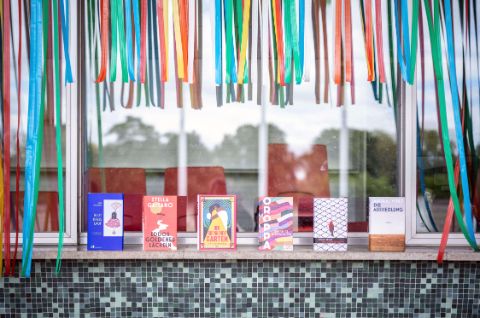
Photo: Mathias Völzke / HKW
The shortlist for the 2026 edition of the International Prize for Literature 2026 has been finalized. Haus der Kulturen der Welt (HKW) is glad to announce the titles, authors, and translators.
The state of emergency is not a temporary phenomenon. It is the norm of human existence. The books on this year’s shortlist tell six tales of its prevalence: about people falling out of our species, because falling out of our species is the history of our species.
Das Gewicht der anderen describes systematic ravages in Iranian prisons: the torture, the mass executions, the register of post-revolutionary fear. Until only a smile remains, the archaic reflex of an oppressed being, as the ultimate response to all things. And the rumour of a person who, decades on, must reconstruct the remains of their damaged life.
No form is enough to make the loss of home bearable. Which is why Blutkreislauf selects various forms for its homesickness, for its probing of exiled speech. In this Belarusian family novel, after the longest goodbye even the poem must give up what it once knew; in order to be able to remember again in the form of a letter.
War reduces human beings to their most elementary form: to the immanence of wounded flesh; to bodily functions; to the senses remaining to the protagonist in Eddos Goldenes Lächeln during the war in South Sudan. She must use her sense of smell, that replaces language because it needs no voice, to make her way to the North.
Der brennende Garten tells of the outbreak of the civil war in Sri Lanka: not in the language of horror, but in a documentary prose that knows the vivid images. Here, every body is merely a proof of experience: this was done to her, this is what happened to him there.
The fate of the characters in Oroppa is also the consequence of the political situation to which they are exposed. The novel is an exegesis of longing: the excessive history of a continent that speaks of those seeking protection, of the disposable and the discarded, those already standing on the fringes of Europe and those still waiting on the coasts of North Africa.
Die Aussiedlung recounts the deportation of a mother who spends four years travelling the plains of Eastern Romania with her children, telling of the holes in the ground where they sleep and the bones they collect in small bags. A story of biblical proportions, written with bated breath, in sentences that reflect the human need for salvation, and which therefore know no end.
These six novels are presented below. Their translation into German reminds us once again that falling out of our species is the same as falling into our species. And that the fragile idea of freedom only acquires dignity and meaning in the absence of freedom. —Senthuran Varatharajah
Blutkreislauf
Julia Cimafiejeva
Translated from Belarusian by Tina Wünschmann
Berlin: Edition.fotoTAPETA, 2025
Oroppa
Safae el Khannoussi
Translated from Dutch by Stefanie Ochel
München: Carl Hanser Verlag, 2026
Eddos Goldenes Lächeln
Stella Gaitano
Translated from Arabic by Larissa Bender
Köln: Kiepenheuer & Witsch, 2026
Der brennende Garten
V. V. Ganeshananthan
Translated from the English by Sophie Zeitz
Stuttgart: Tropen Verlag, 2025
Das Gewicht der anderen
Bahram Moradi
Translated from Farsi by Sarah Rauchfuß
Göttingen: Wallstein Verlag, 2025
Die Aussiedlung
András Visky
Translated from Hungarian by Timea Tankó
Berlin: Suhrkamp Verlag, 2025
Reader
German reading samples in the shortlist reader for the shortlist [PDF; ca. 1,2MB]