Where the Tirailleurs’ Stories are Heard
Listening Sessions with Nischal Khadka und Mohamed-Ali Ltaief
Listening Sessions
Sun., 14.6.2026
16:15–17:00
Safi Faye Hall
Mohamed-Ali Ltaief, I Hear the Old Sound of The World’s Future (2026)
In English
Free entry
Sun., 14.6.2026
15:30–16:15
Safi Faye Hall
Nischal Khadka, What Can a Song Do to You (2025–26)
In English
Free entry
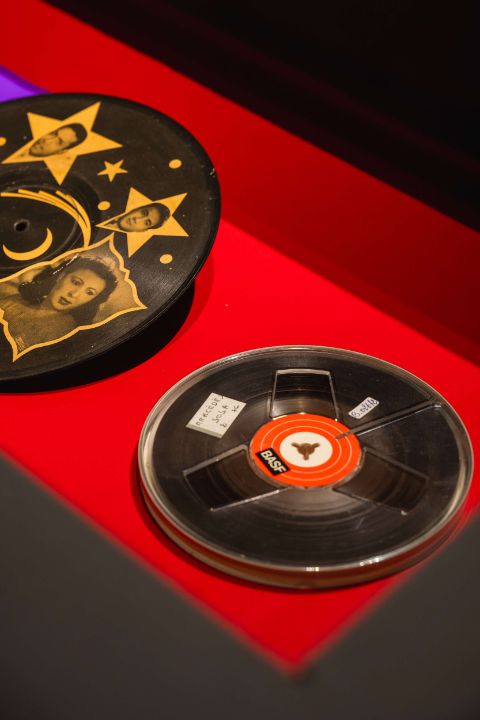
Mohamed Ali Ltaief, I HEAR THE OLD SOUND OF THE WORLD'S FUTURE (2026), exhibition and research, B7L9 Art Centre in Tunis. Photo: Mehdi Ben Temessek
Nischal Khadka, What Can a Song Do to You (2025–26)
Listening Encounter, with Himalayan Gongs and Cymbals
What does a song do when it outlives the singer? What does listening become when history speaks through breath, crackle, and loss? How might sound function as an archive of both violence and survival? For this listening session, Nischal Khadka engages with the experiences of Nepalis recruited under British colonialism and forced into military training and wars not of their own. Thousands of them were held in German prison camps during the First World, such as in Wünsdorf, on the outskirts of Berlin, yet their histories remain little known in the city.
While colonial narratives labelled Nepali recruits as ‘Gurkhas’ and constructed the myth of the ‘martial race’, the term previously referred to Gorkha, a hill region in Nepal from which many were recruited. During their imprisonment in camps in Germany, they were subjected to another form of extraction: scholars recorded their voices and languages as part of colonial ethnographic projects. Working with and against these sound collections, as Saidiya Hartman proposes, Khadka approaches these archives as a contested space where violence, but also memory and survival continue to resonate.
The listening session draws on the song of Jas Bahadur Rai, a Nepali recruit who never returned from captivity. Recorded in 1916 under these conditions of imprisonment, his song survives today on a set of fragile wax cylinders. Through close listening and present-day field recordings made in Wünsdorf, Khadka unfolds multiple layers of histories and emotions, imagining possible paths for Bahadur Rai to escape the prison camp. Khadka relates the song to his own experiences as a Nepali who emigrated to Berlin, situating it within Nepali folk music tradition and giving attention to the lyrics that recall the Gorkha landscape. In doing so he facilitates an acoustic encounter across generations and affirms singing as a space of anti-colonial belonging.
Mohamed-Ali Ltaief, I Hear the Old Sound of The World’s Future (2026)
Lecture Performance and Listening Act
This lecture performance and listening act unfolds the connections between sound, poetry, and art histories by revisiting early twentieth-century North African sonic archives. Mohamed-Ali Ltaief investigates sound recordings that refuse the colonial apparatus, inviting the audience to listen differently, recognizing how sound continues to echo today. The work draws on the vocal recordings of North African Tirailleurs held as prisoners in German war camps during the First World War. In this listening act, Ltaief puts Tirailleurs poets and musicians in dialogue with cultural practitioners of the period, creating a modern art history that defies the epistemic violence of colonialism. Included in the lecture performance are the voices of the Tunisian poets and singers Younes and Othmane (held at the Wünsdorf camp in Brandenburg), and the Somali poet Mohamed Nur (held at the Ruhleben camp in Berlin).
The recordings have been accessed thanks to the support and resocialization of the Centre for Arab and Mediterranean Music at the Ennejma Ezzahra in Tunis, alongside the Berliner Phonogramm-Archiv, the Lautarchiv of Humboldt-Universität, Berlin, and the Institut Mémoires de l'Edition Contemporaine (IMEC) in France. They were also traced through counter-archives, such as in independent music label catalogues, including Oum-El-Hassen (Tunis, dating from the 1930s), Rsaïssi (Tunis, 1930s), Fiesta (Paris, 1940s), Macksoud (New York, 1910s–1930s), and Alamphon (US, 1950s).
The performance and listening act forms part of Mohamed-Ali Ltaief’s I Hear the Old Sound of The World’s Future (2026), an exhibition and research project, developed by the Kamel Lazaar Foundation in collaboration with Ibraaz London and Archipel festival in Geneva.