Othon Friesz
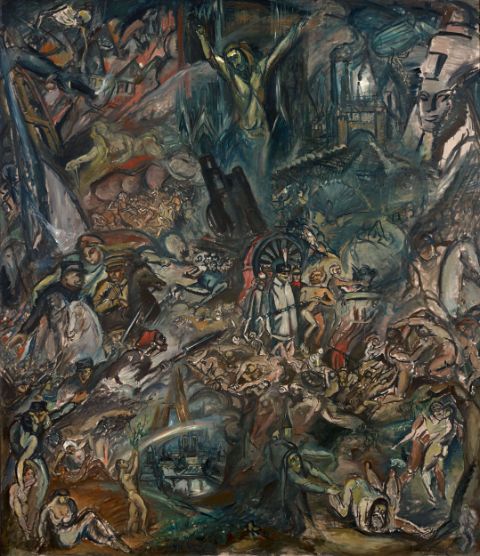
Othon Friesz, La Guerre (1915). Photo: Ville de Grenoble/Musée de Grenoble—J. L. Lacroix
Achille-Émile Othon Friesz, known as Othon Friesz, was a representative of Fauvism, a pioneering avantgarde movement of the early twentieth century that elevated colour and planar constructions to primary means of artistic expression. While recovering from a shrapnel wound sustained during the First World War, he created the painting La Guerre. It transforms the horrors of war into a multilayered, chaotic tableau that reflects a world out of joint in both form and content. A charging Tirailleur with a red chechia and a fixed bayonet rises like an arrow towards the centre of the image. He is surrounded by historical figures and events, including Kaiser Wilhelm II, the commanders-in-chief of the French and British armies, and the destruction of Reims Cathedral, alongside biblical and allegorical motifs. It is one of the few paintings to depict a Tirailleur as an equal, endowed with the same agency as the other figures. In muted colours and with expressive dynamism, crowds of faceless soldiers, burning cities, and piles of corpses coalesce into an allegory of human violence and suffering. Its haunting power echoes Goya’s The Disasters of War and Bosch’s apocalyptic visions. In 1916, Othon Friesz was part of a group of artists advocating the creation of a Panorama de la Guerre, a large circular painting depicting scenes of the war and German atrocities, designed to sway the populations of neutral countries, such as the United States, to enter the conflict. However, the project remained unrealized. In the mid-1930s, French Foreign Minister Aristide Briand commissioned Friesz to create La Paix, an allegorical counterpart to La Guerre. Conceived as a tapestry for the Palace of the League of Nations in Geneva, its installation was thwarted by political tensions on the eve of the Second World War.
Work in the exhibition: La Guerre (1915), oil on canvas, 300 × 260 cm, reproduction. Courtesy of Ville de Grenoble/Musée de Grenoble—J. L. Lacroix