Mónica de Miranda
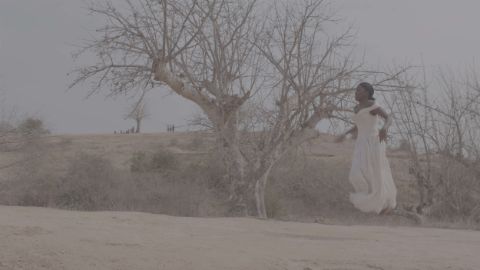
Mónica de Miranda, The Spell Stone (2026), video still. Courtesy of Mónica de Miranda Art Studio
Via an interdisciplinary practice that critically engages with the convergence of politics, gender, memory, space, and history, Mónica de Miranda uses drawing, installation, photography, film, and sound to retrace the boundaries between documentary and fiction. The Spell Stone (2026) is a multiscreen video installation that centres on freedom fighters who were at the front lines of Angola’s armed struggle against Portuguese colonialism. The installation is hosted within a starshaped structure, a symbol of African freedom, unity, and leadership. The protagonists speak in detail about the labour and fortitude required to dismantle colonial power, challenge colonial hierarchies, and keep a movement going. Miranda foregrounds the subjective dimension of what is often abstractly subsumed under general terms such as ‘movement’ and ‘struggle’: words that often fail to grasp the very personal dimensions of such grand investments in the uncertain futures of nascent nation states. The Spell Stone resonates with Amílcar Cabral’s work on the role and importance of cultural reclamation for deep liberation that goes beyond colonial statehood, as well as Achille Mbembe’s notion of terrestrial communities that are predicated on the cultivation of a grounded community shaped by relationality, embodiment, and bonds of care.
Co-produced by Mónica de Miranda and Haus der Kulturen der Welt (HKW), 2026
Work in the exhibition: The Spell Stone (2026), 4-channel video installation, video, wood, dimensions variable, Portuguese with En/Ger subs. Courtesy of Jahmek Contemporary Art/Kintop