Félix Vallotton
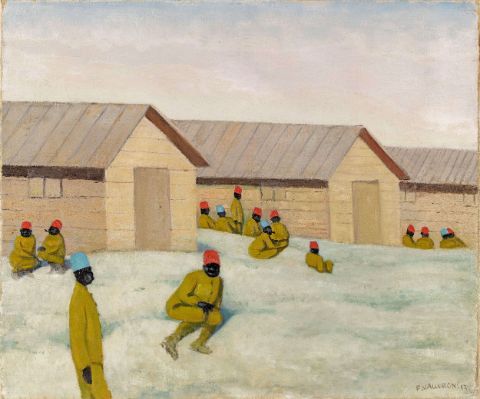
Félix Vallotton, Soldats sénégalais au camp de Mailly (1917). bpk / GrandPalaisRmn / René-Gabriel Ojéda
Félix Vallotton gained recognition in Paris for his wood engravings and paintings from the late 1890s onwards. A member of the Symbolist group Les Nabis since 1892, he also contributed to Post-Impressionist painting at the turn of the century. His work shifted during the First World War, when he documented and reflected on these realities. In his series of woodcuts, C’est la Guerre (1915–16), Vallotton condemns the violence of war through motifs such as devastated landscapes, explosions, and wounded people. In 1917, he joined the front as a volunteer artist for the French state, documenting life in the trenches in north-east France, as part of a programme to create a collection of historical paintings. During this time, the artist reflected in his journal on the alleged meaning of art in this context: ‘While men are suffering and fighting, what does the act of painting mean?’ Of the fourteen paintings created from this experience, two reproductions are included in the HKW exhibition as artworks that document the engagement with the lives and sacrifices of the Tirailleurs. While the painting Soldats sénégalais au camp de Mailly (1917) depicts them at the camp in a moment of rest, foregrounding their camaraderie rather than the disciplinary control characteristic of colonial camp imagery, the painting Cimetière militaire de Châlons-sur-Marne (1917) shows the numerous rows of graves in the cemetery, in which no names can be read. The painting is a testament to the countless sacrifices made by unrecognized soldiers, while the war was still raging in 1917.
Works in the exhibition: Soldats sénégalais au camp de Mailly (1917), oil on canvas, 55.2 × 66 cm, reproduction (original 46 × 55 cm). bpk / GrandPalaisRmn / René-Gabriel Ojéda; Cimetière militaire de Châlons-sur-Marne (1917), oil on canvas, 64.8 × 96 cm, reproduction (original 54 × 80 cm). Collection La Contemporaine / BDIC_OR_F1_000060