Mehdi Nassouli | Gnawa Diffusion
Concerts
19:00–20:00 Mehdi Nassouli
20:30–22:00 Gnawa Diffusion
Fri., 17.7.2026
19:00–22:00
Paulette Nardal Terrace
€24 / reduced €20
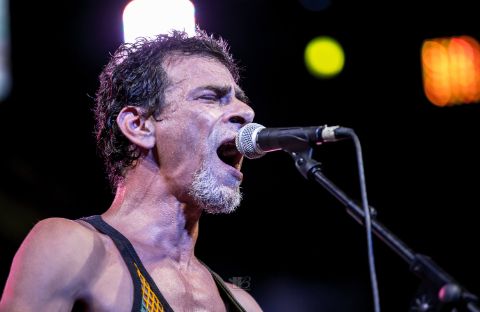
Gnawa Diffusion. Photo: Hakim Bouafia
Mehdi Nassouli
The enfant terrible of Gnawa. Mehdi Nassouli, born in 1985 in Taroudant—the city in the southern Moroccan region of Souss where the Amazigh culture, Malhoun, Gnawa, and the local Deqqa Roudania exist side by side in a single fabric of sound—is the guembri player of a generation now making something new out of this diversity. Having grown up in a family shaped by Gnawa traditions, he spent a decade travelling in his own country studying the specific schools of each region with their respective maalems—a travelling education in which Morocco’s musical cultures appeared not as borders, but as interlocking languages. This resulted in a mobility that has led him to a wide variety of encounters: with the Titi Robin, whose albums Les Rives (2012) and Taziri (2015) his playing helped to shape; with Hindi Zahra, Fatoumata Diawara, Alpha Blondy, Nneka, Hamed Sultan, Justin Adams, Karim Ziad; in the trans-mediterranean tribute project Bob Maghreb, in the electronic universe of Sofyann Ben Youssef’s Ammar 808, in the pan-African collective Jokko. But wherever he performs, he is above all one thing: a guembri player with an extraordinary presence who draws from his instrument not only rhythm, but also song—doing so with a distinctive, bright, agile voice that can move back and forth without breaks between Tagnaouite litany and Malhoun poetry. It makes sense to open this evening’s programme with his concert: before the narrow ritual circle of the lila closes at SAVVY later in the night, Nassouli once again opens up the full range of what Gnawa can be today—a lively, permeable, wandering heritage.
Gnawa Diffusion
Snappy, danceable, intransigent. Gnawa Diffusion, founded in 1992 in Grenoble around the charismatic singer and guembri player Amazigh Kateb, paved the way for a whole generation including Bab L’Bluz, Mehdi Nassouli, and many others. It was the first band to blend Gnawa with reggae, dub, rock, chaabi, and hip-hop to create a single, powerful sound, without getting lost in folklore or arbitrariness. And Gnawa Diffusion were the first to combine this with a political focus that is still peerless: lyrics in Algerian Arabic, Tamazight, French, and English, sarcastic, mordant, often dangerously topical—addressing poverty in Algeria, the corruption of those in power, the hypocrisy of religions, the wars of empires—but still danceable, hymn-like, getting under people’s skins and binding them together. Amazigh Kateb, born in 1972 in Algiers, is the son of Kateb Yacine, the father of modern Algerian literature; his given name, ‘Amazigh’, is Tamazight for ‘free man’—a programme espoused by the band. Having grown up with the theatre run by his father, who emigrated to France in 1988, he founded Gnawa Diffusion in the suburbs of Grenoble in the spirit of a postcolonial experience in which voices from the Maghreb, the Caribbean, and the whole of Africa meet—a sound that doesn’t explain the history of the diaspora but translates it into music. Albums like Algeria (1997), Bab el Oued – Kingston (1999), Souk System (2003) and Fucking Cowboys (2006) are now classics. The band made its biggest impact at the height and the end of the Algerian Civil War when their songs became hymns for an entire young generation. With their performance in Berlin, they close the circle opened up by the festival over four weekends: here is a band whose long history shows what’s at stake here—Gnawa not as a historical form of cultural heritage but as a vibrant, polyphonic, politically aware, and danceable sound of the world.