Justin Adams & Mauro Durante with special guest: Alessia Tondo | Majid Bekkas & Bassekou Kouyaté
Concerts
19:00–20:00 Justin Adams & Mauro Durante with special guest: Alessia Tondo
20:30–22:00 Majid Bekkas & Bassekou Kouyaté
22:00–00:00 DJ-Set (Magnus Hirschfeld Bar)
Sat., 27.6.2026
19:00–00:00
Paulette Nardal Terrace
€24 / reduced €20 (Evening ticket)
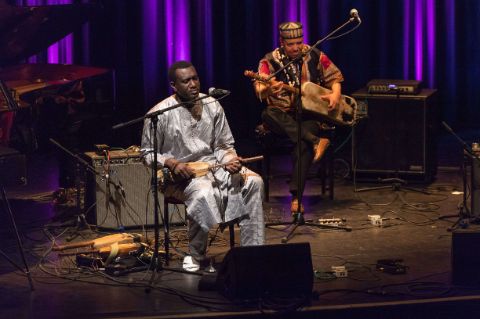
Majid Bekkas & Bassekou Kouyaté. Photo: Richard Dannemann
Justin Adams & Mauro Durante with special guest: Alessia Tondo
What was planned as a brief encounter turned into a highly successful and long-lasting touring partnership. Since 2020, guitarist Justin Adams and violinist and percussionist Mauro Durante from Apulia, the home of the tarantella, have been speaking a shared musical language, expanding their original duo to include Alessia Tondo from the Canzionere Grecanico Salentino and, on occasion, Yousra Mansour from the Gnawa band Bab L’Bluz. As a four-piece, they perform as the trans-mediterranean project Almare; at HKW they will play as a trio, with Yousra Mansour playing a few days later with her own band Bab L’Bluz. To date, Adams and Durante have released two award-winning albums: Still Moving (2021) and Sweet Release (2025). Both are grounded in Durante’s tarantella background with its South Italian pizzica and tammurriata rhythms. In Salento, the peninsula in Apulia where he lives, Mauro Durante is the director of Canzionere Grecanico Salentino, an award-winning group founded by his family in 1975 that has since performed at many major festivals around the world. He has preserved and renewed the pizzica and tarantella traditions, making them known globally. Guitarist and producer Justin Adams is known above all for his work with Robert Plant, Sinead O’Connor, Tinariwen, and Rachid Taha. Since spending his childhood in the Middle East, he has been in thrall to the music of North Africa. This concert showcases the close ties between Gnawa and tarantella, both of which can sooth and heal dancers with minimalist, trance-inducing rhythms. The tarantella was originally created to cure spider bites. While working in the fields, those living in the Southern Italy often came into contact with tarantulas, whose poison they hoped to sweat out by sustained ecstatic dancing. Out of solidarity, the whole village community joined in with the dance, actively participating in the healing.
Majid Bekkas & Bassekou Kouyaté
The fact that Majid Bekkas and Bassekou Kouyaté share the stage at this festival feels almost natural—but it is nonetheless an event. Bekkas, known in Morocco and beyond simply as ‘Mister Magic’, is one of those rare multi-instrumentalists whose encounters with outstanding musicians from all continents always find both the shortest and the most beautiful route. Decades ago, when Gnawa was still primarily viewed as a purely ritual form of music, he was among the first maalems to deliberately relaunch the dialogue between this music and its sub-Saharan roots—the world from which Gnawa itself originally came to Morocco via the trans-Saharan caravan routes. Bekkas’s own family is from Zagora, the south Moroccan gateway to the desert which, under Ahmed Al-Mansour in the sixteenth century, linked Marrakesh with Timbuktu—the same ground on which Bassekou Kouyaté stands today. Kouyaté, born on the banks of the Niger in the old Ségou Empire, is the undisputed revivor of the ngoni—the archaic spike lute that would, via the trade routes of the Atlantic slave trade, eventually give rise to the American banjo, and which is also closely related to the guembri. When Bekkas and Kouyaté play together, then, rather than seeking bridges between disparate worlds, their music reaches down into the shared ground from which the two traditions grew. Both have pursued impressive careers in music: Bekkas with Archie Shepp, Randy Weston, Pharoah Sanders, Joachim Kühn, and Klaus Doldinger, on pioneering albums like African Gnaoua Blues (2002) and Magic Spirit Quartet (2020); Kouyaté with Toumani Diabaté in his Symmetric Orchestra, on Ali Farka Touré’s last album Savane (2006), with Taj Mahal, Béla Fleck, Damon Albarn, and Bono, as well as milestones of his own like Segu Blue (2007), I Speak Fula (2009), and Ba Power (2015). Two masters, two spike lutes, a single long line across the Sahara: what this concert offers is not so much a fusion as a homecoming.