Gnaouas | Gnawa Music—Corps et Âme
A Film Night with Izza Génini
Film Screenings, Conversation
Thu., 2.7.2026
21:00–23:00
Safi Faye Hall
Free entry
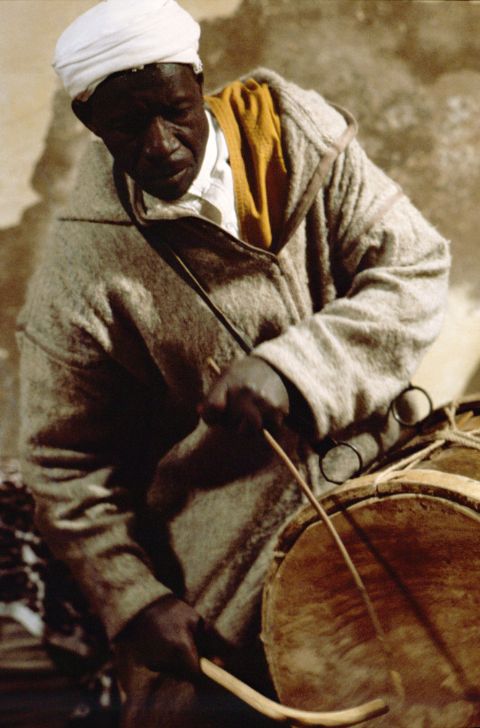
Film still from Gnaouas.
A rare encounter. Izza Génini, who was born in 1942 in Casablanca and who has lived in Paris since she was eighteen, is an icon: pioneer of Moroccan documentary film; producer of Ahmed El Maanouni’s legendary El Hal / Transes (1981) about Nass El Ghiwane, a film Martin Scorsese had restored decades later for his World Cinema Project; founder of the Paris distribution company responsible for making much of Moroccan and pan-African cinema visible in Europe. Above all, however, she created the monumental series Maroc, corps et âme, a filmed encyclopaedia of Moroccan music that has been growing since 1987 and that is now considered the most important audiovisual archive of her home country’s sonic landscape.
HKW is delighted to welcome her in person in Berlin, following a screening of two films that read like two chapters of a single book. The first she made herself: Gnaouas (1989), the first film ever to focus exclusively on Gnawa music—a lila somewhere between Marrakesh and Essaouira, documented in that rare blend of ethnographic precision and cinematographic tenderness that has become the trademark of her series.
The second is Frank Cassenti’s Gnawa Music—Corps et Âme (2010), awarded with the SACEM prize in 2011, that picks up the story two decades later: a musical road trip from Tangier to Essaouira with the unforgettable maalem Mahmoud Guinia—a legend in his own right, who died in 2015—with Majid Bekkas, and other great masters of the tradition. The fact that Cassenti echoes the title of Génini’s series in his subtitle is not a coincidence but a conscious continuation: the same dedication to sound as the carrier of a culture, the same patience in the face of mystery. The screening will be followed by a discussion with Izza Génini, one of the most important voices on Morocco’s visual culture.