Asmaa Hamzaoui & Bnat Timbouktou
Concert
Fri., 10.7.2026
19:30–21:00
Paulette Nardal Terrace
€20 / reduced €18
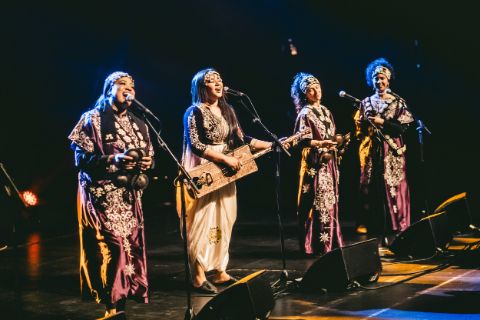
Asmaa Hamzaoui & Bnat Timbouktou. Photo: Lais Pereira
For centuries, only the hands of male maalems touched the guembri—until the arrival of Asmaa Hamzaoui. With her concert, she opens two days of the festival devoted to the women in Gnawa culture. In a ritual universe where women always performed the central role of the mqaddma—the healer who prepares the lila, guides the trance, and establishes contact with the spirits—the role of playing the three-stringed spike lute had always been reserved for men. This unwritten but ironclad law was broken in 1998 by a Casablanca-born maâlma. Asmaa Hamzaoui is the daughter of the maalem Rachid Hamzaoui, a respected member of the Casablanca brotherhood, and a Sahrawi dancer. Both sides, the maternal line from the southernmost part of Morocco and the paternal line from the venerable Tagnaouite school, come together in her. The break with tradition came when her father began teaching her the guembri at age seven; at twelve he took her with him on tour and finally gave her his own instrument, which he had inherited from his master. In 2012, aged fourteen, she founded Bnat Timbouktou (Daughters of Timbuktu), together with her sister Aicha and their childhood friend Soukaina Elmeliji. Their performance at the Gnaoua Festival in Essaouira in 2017 was a taboo-breaking moment that was to prove historic; it was followed in 2019 by the internationally celebrated debut album Oulad Lghaba (Children of the Forest) on the Swedish label Ajabu! Records, and in 2024 by the sequel L’bnat, as well as concerts from New York to WOMEX Tampere and an encounter with Fatoumata Diawara. The band’s name is programmatic: Bnat Timbouktou recalls the city from which people were deported across the Sahara, finally arriving in Morocco—as well as naming the daughters of a legacy that long remained closed to them, but that never abandoned them. Seeing them on stage today, one hears not just music, but a correction: the rediscovery of a female voice at the centre of a ritual in which it was always at home.