MAJEMUK: Extended Concert
Ariel William Orah
Performance
Sat., 6.12.2025
21:00
Angie Stardust Foyer
Free entry
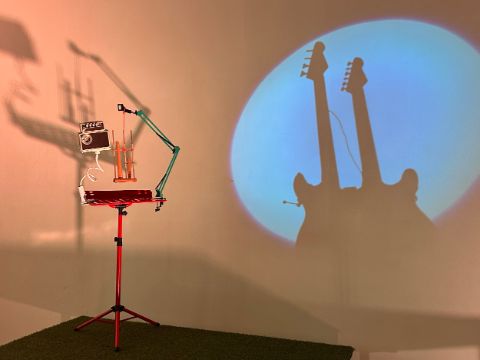
Ariel William Orah, Majemuk (2025). Photo: Courtesy of the artist
Majemuk, an Indonesian word meaning ‘plural’ or ‘composite’, marks Ariel William Orah’s artistic research on the historical imagination of the 1955 Bandung Conference—the first Afro-Asian conference in modern history. Bandung’s unfinished ideals of solidarity, coexistence, and plurality provide the framework through which Orah examines how such visions resonate in the present.
Stemming from Orah’s research fellowship and installation at the Akademie der Künste Berlin’s exhibition Every Artist Must Take Sides – Resonances of Eslanda and Paul Robeson, the performance MAJEMUK: Extended Concert continues this inquiry. As a polyphonic and polyvisual performance, the work echoes HKW’s exhibition examining the global polycrisis brought by the political and cultural tendency towards contemporary fascism. The performance considers what it means to practice plurality today, unfolding as an empathy exercise in collective listening and asking: How can we learn to hear one another across different frequencies and unequal grounds?
These threads materialize sonically through two sets of bamboo instruments known as Angklung—one Sundanese pentatonic, another adapted to Western tuning—intertwined with a modified double-neck bass and guitar built by Orah as a sonic representation of the Robesons. Together with voice recordings captured through vintage German microphones at the Studio für elektroakustische Musik der Akademie der Künste, the work at HKW expands into an eight-channel audio field and a multi-channel video installation edited by Asarela Dewi, Orah’s colleague from sōydivision—forming a dialectic between purity as a fascist-oriented aesthetic ideal and the plurality of listening and viewing as a resistant strategy.