The Circle as Living Heritage
Bullerengue Workshop mit Valeria Pacific
Music and Dance Workshop
Sun., 14.12.2025
15:00–17:00
Haunani-Kay Trask Hall
In Spanish and English. German-language assistance possible.
Free entry
Followed by a Rueda at 17:00
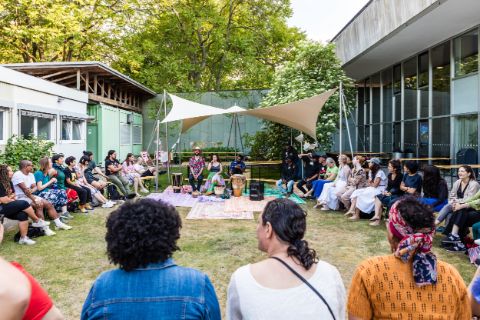
Photo: Laura Fiorio/HKW
The workshop The Circle as Living Heritage offers an immersion into Bullerengue an Afro-Colombian tradition kept alive for generations by communities on the Caribbean coast. Rather than a performance, Bullerengue is a communal ritual built around the circle: a space for dialogue between the call-and-response chants, the drums, and the movement of its participants.
Inside and around that circle, rhythm carries historical forms of resistance. During the brutality of colonial rule in the Americas, in many places the playing of drums and dancing of rhythmic patterns from Africa was prohibited and deemed ‘vulgar’ by those in power. In the face of such oppression, drumming was used by many Afro-diasporic communities to send clandestine messages, and opportunities to dance together were used to organize uprisings. As a way of affirming Maroon and Afro-centric culture despite colonial repression, such cultural expressions have endured into the present day, and remain resonant in the face of entrenched structural racism in contemporary society.
The workshop at Haus der Kulturen der Welt (HKW) invites attendees to engage with this living heritage not as spectators, but as part of a collective where the act of gathering itself echoes Bullerengue’s resilient origins. It is an opportunity to explore how memory is carried in the body, understanding rhythm not merely as sound, but as a means of perseverance and community formation. The session is conceived as a space of respectful practice, exploring the foundational forms of Bullerengue through song, dance, and rhythm while acknowledging the profound cultural significance of the tradition.
The workshop is facilitated by drummer and pedagogue Valeria Pacific, co-director of Bullerengue Circle, a community interest organization that has been key to the growth of a European Bullerengue community and international awareness of this ancestral tradition. Over the course of two hours, Valeria shares knowledge gained through performing with and researching practitioners of various palenques and locations in Colombia, as well as people from the Colombian diaspora. This work has also encompassed the support of training and educational programmes for young people in Palenque and Turbo, and the creation of such spaces in London. Through this trajectory of creative practice, Valeria has engaged in the making of an inclusive pedagogy that upholds Bullerengue’s political and cultural values.
The workshop precedes a Bullerengue Rueda of the same duration, during which all visitors are invited to engage further with the practice of this art form. Both sessions are part of a long-term commitment by HKW to nourish the rooting of Bullerengue in Berlin, promoting its art and artists while bringing and keeping communities together while they learn, embrace, and respect each other’s culture and people.