When Pixels Wash Ashore
Marina Otero Verzier
Performance Lecture
Sat., 23.5.2026
18:30
Safi Faye Hall
In English with simultaneous German translation
Free entry
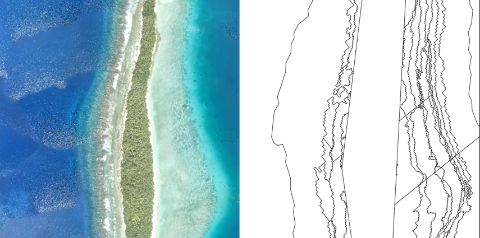
Dan Miller and Marina Otero Verzier, When Pixels Wash Ashore (2024), film stills. Courtesy of the artists
When Pixels Wash Ashore is a video installation centred on Tuvalu, a Pacific island nation facing imminent submergence as sea levels rise under accelerating global warming. In response to the potential loss of its physical homeland, the government of Tuvalu plans to become fully virtual, transferring the nation’s existence to the cloud. As humans witness the escalating impacts of the climate crisis, the creation of Tuvalu’s digital twin raises urgent questions about the difficulty in finding adequate responses to the fragility of environments and communities. In this performance lecture, the work also explores the complex tension between digital custodianship and the unsustainable practices of the digital industry; refusing to hand over data to the Big Tech infrastructure may result in erasure from global narratives and archives, but doing so means giving up on the complexities and affective relations that shape traditional knowledge and cultural heritage. How can we care for, preserve, and ultimately mourn the loss of tangible and embodied spaces in the face of climate catastrophe? And is there potential in the infrastructural remaking of a nation that finds itself without territory?
When Pixels Wash Ashore brings digitization and statecraft into relation, drawing on critical cartographies to rethink how territory and its demarcation are defined. The project dissects how states measure and determine territories at their breaking points, and how the spatial and temporal tools used to map the impacts of climate change reveal the fragility of territorial frameworks. It questions the reliance on remotely sensed data to represent the impacts of the climate crisis—especially when such data is susceptible to distortion, degradation, or concealment—while the offline conditions result in the physical location of Tuvalu becoming environmentally unstable.