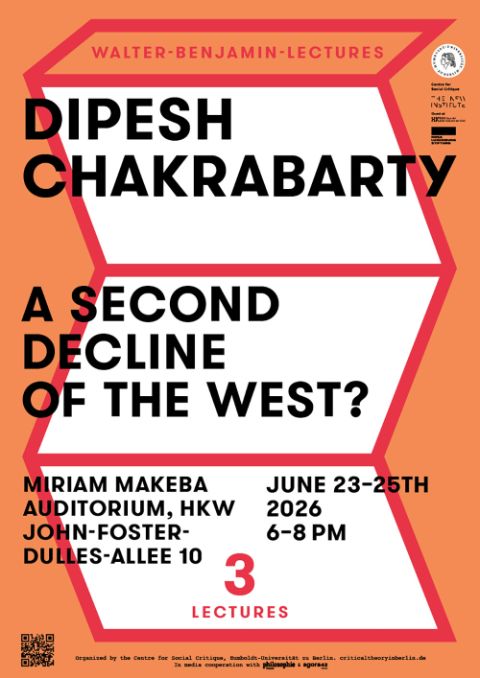
Walter Benjamin Lectures: Dipesh Chakrabarty
- Lectures
HKW hosts
Tue., 23.6.2026
18:00–20:00
Miriam Makeba Auditorium
The Between and Betwixt Nature of Our Times
Free entry
Wed., 24.6.2026
18:00–20:00
Miriam Makeba Auditorium
Globalization and the Politics of Provincializing Europe
Free entry
Thu., 25.6.2026
18:00–20:00
Miriam Makeba Auditorium
Indigeneity as Planetarity: Provincializing America?
Free entry
In English with simultaneous German translation
Detailed programme information on criticaltheoryinberlin.de
About Walter Benjamin Lectures
Each year the Centre for Social Critique at Humboldt University invites a leading critical theorist to Berlin to give the public Walter Benjamin Lectures. On three consecutive nights, the lectures present an up-to-date analysis of the crises of our time and ways to overcome or grapple with them. Named after the Berlin-born philosopher Walter Benjamin, the lecture series is dedicated to his intellectual integrity and political commitment in the face of historical catastrophe. The list of lecturers since 2019 comprises Charles Taylor, Nancy Fraser, Axel Honneth, Sally Haslanger, Lea Ypi, and Tommie Shelby.
In 2026, the Benjamin Chair at the Centre will be held by the internationally recognized historian Dipesh Chakrabarty. A quarter of a century after the publication of his seminal work, Provincializing Europe, the author will pose the question of whether the multiple ecological catastrophes that have befallen the planet necessitate the provincialization of humanity itself.
Topic
The rise of authoritarian tendencies and xenophobic cultures in the democracies of the world, the transformation of China into a technological and economic power-house, and global forms of terrorism are often seen as successive tipping points in a long-term narrative—available in a variety of forms since at least Oswald Spengler’s magisterial formulation of it—of the “decline” of the West. When we add to these factors the uncertainties associated with various environmental problems of a planetary scale, unprecedented developments in technology, and demographic prospects of humanity, the acceleration of modernization seems at last to be at odds with the values of modernity. The metaphor of decline of one civilization that yields place to another seems all too inadequate to capture the sense of crisis that seems not to be a matter of one civilization alone.
This series of lectures explores the meaning of the multiple challenges faced by humanity by revisiting the project of provincializing Europe that I once essayed twenty-five years ago. Would the renewal of the aspiration to emancipatory human futures that was once a flawed, contested, but universal legacy of Europe’s colonization of other peoples’ lives and lands, now require us to provincialize America or even humanity itself?
About Dipesh Chakrabarty
Few contemporary thinkers have changed our understanding of history and the modern world as deeply as Dipesh Chakrabarty. Chakrabarty is the Lawrence A. Kimpton Distinguished Service Professor of History and South Asian Languages and Civilizations at the University of Chicago, a founding member of the Subaltern Studies Collective, and a founding editor of Postcolonial Studies. Connecting postcolonial and planetary perspectives, his work has transformed the way we make sense of our present. Chakrabartyʼs books greatly illuminate how so-called global modernity emerged through entanglements of empire, labor, and ecological processes. By bringing in philosophical insights and experiences of the Global South, Dipesh Chakrabarty reveals that the Eurocentric narrative of progress and emancipation never described a self-contained process. He opens up a planetary perspective sensitive to the effects of capital and colonial power. More recently, Chakrabarty has argued that humanity, differentiated by culture and global power relations, has profoundly impacted planetary conditions in ways to perdure the present for a long time. Drawing on Earth system science, he decenters the role of human agency in history and invites us to rethink politics, responsibility, and freedom from beyond the human vantage point. For Chakrabarty, planetary awareness reveals the limits of the nation-state and the ambivalent role of modern technology.
For his outstanding contributions, Chakrabarty has received the Toynbee Prize, honorary doctorates from the Universities of London and Antwerp, and from the École Normale Supérieure, Paris. He has been elected a Fellow of the American Academy of Arts and Sciences, an Honorary Fellow of the Australian Academy of the Humanities, and a Corresponding Fellow of the British Academy. Among his most important books are Rethinking Working-Class History (Princeton 1989), Provincializing Europe: Postcolonial Thought and Historical Difference (Princeton 2000), The Crises of Civilization: Exploring Global and Planetary Histories (Oxford 2018), The Climate of History in a Planetary Age (Chicago 2021), and One Planet, Many Worlds: The Climate Parallax (2023).